Madeira wine guide: estufagem, grapes, age labels and Funchal lodges
How Madeira wine is made under the IVBAM rules, what Sercial, Verdelho, Boal and Malvasia mean, how to read age statements and labels, and which Funchal lodges you can visit.
28 October 2026 · 6 min read
Madeira wine is a fortified wine made only in the Madeira wine region and protected by the designation of origin DO «Madeira». Fermentation is stopped with grape spirit, and the wine is then aged either by controlled heating (estufagem) or by years in wooden casks in warm lofts (canteiro). That ageing gives Madeira its oxidative style. Its production and labelling are set by regional rules from 2015 and supervised by IVBAM, the Madeira Wine, Embroidery and Handicraft Institute.
Key facts
- Regulator: IVBAM, IP-RAM (Instituto do Vinho, do Bordado e do Artesanato da Madeira), based in Funchal.
- Alcohol: 17% to 22% vol. (15.5% vol. allowed only as an exception, with IVBAM authorisation).
- Fortification: neutral grape spirit of at least 96% vol., added during or after fermentation.
- Estufagem: heating at no more than 50 °C for at least 3 months.
- Canteiro: at least 2 years in wood; a canteiro wine cannot be bottled before 3 years, counted from 1 January after the harvest.
- Age statements allowed: 5, 10, 15, 20, 30, 40, 50 and "more than 50" years.
Where does Madeira wine's style come from?
IVBAM's official wine site dates the discovery of Madeira to 1419 and says vines were among the first crops, with wine exported within 25 years of settlement. Between the 16th and 18th centuries, export routes ran to the Indies and the Americas. IVBAM notes that the independence of the United States in 1776 was toasted with Madeira.
Long sea voyages through the tropics changed the wine, and buyers came to prefer the heat-aged result. Wikipedia records the name vinho da roda for wines that had made the round trip. In the 18th century, according to IVBAM, producers began to reproduce that effect on land through estufagem. That method has defined Madeira ever since.
The 19th century brought crises. Powdery mildew (oidium) hit in the early 1850s, and phylloxera later destroyed most vineyards. Blandy's, one of the houses that still receives visitors in Funchal, traces its founding as a wine shipper to 1811.
How is Madeira wine made: estufagem or canteiro?
Every Madeira starts the same way. The must needs a natural alcohol content of at least 9% vol. Fermentation is then stopped by adding grape spirit, and the moment of fortification decides how sweet the wine will be. After that, the regulation allows two production processes.
Estufagem. The wine is kept in containers fitted with maximum thermometers, at no more than 50 °C, for at least 3 months. IVBAM's site describes stainless steel tanks heated by hot-water coils at 45–50 °C. Producers must tell IVBAM when estufagem starts, and the institute can take samples, seal the tanks and check the temperature. Estufagem wine can only be bottled at least 3 months after heating, and never before 31 October of the second year after the harvest.
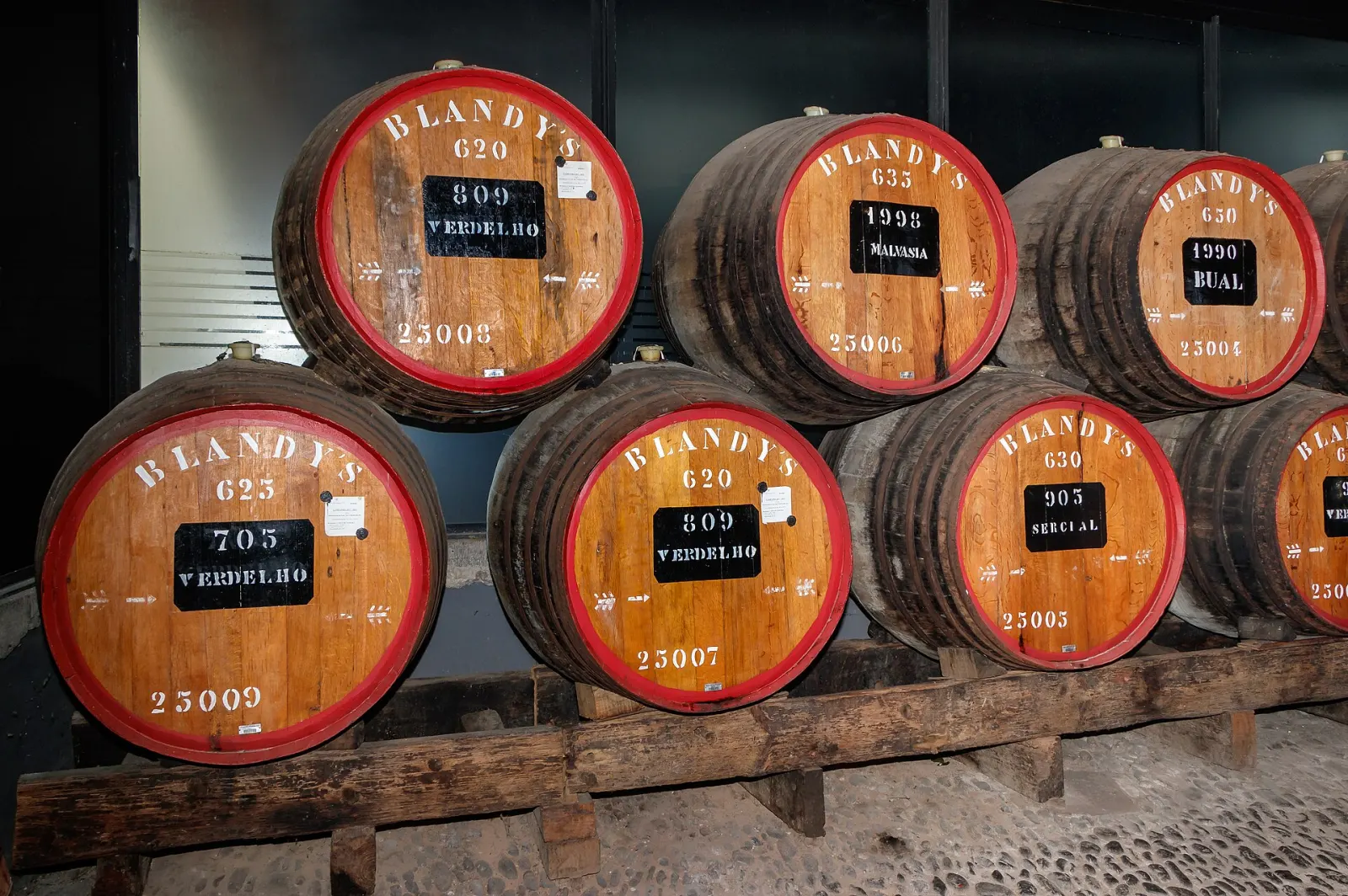
Canteiro. The wine ages in wooden casks for at least 2 years with no artificial heat. IVBAM explains that the casks sit on wooden beams called canteiros, usually on the upper floors of lodges, where it is warmer. A wine labelled "Canteiro" cannot have gone through estufagem.
One practical point for buyers follows from the rules. A vintage-dated Frasqueira must be made by the canteiro process, so heating is never the short cut for the island's top category.
Which grapes and styles should you know?
The regulation links each traditional variety name to a sweetness level. When a label names one of these grapes, the style is fixed:
| Variety on the label | Style required |
|---|---|
| Sercial | Dry or extra dry |
| Verdelho | Medium dry |
| Terrantez | Medium dry or medium sweet |
| Boal / Bual | Medium sweet |
| Malvasia (Malmsey) | Sweet |
Sweetness is defined in degrees Baumé: dry is below 1.5°, medium dry 1–2.5°, medium sweet 2.5–3.5°, sweet above 3.5°, and extra dry 0.5° or less. Wines from other recommended varieties, including Tinta Negra, can be made in any of these styles. That is why those labels must state the sweetness. On a Sercial, Verdelho, Boal or Malvasia, the grape name does that job.
A label may name only one grape variety, and it must be on the recommended list. The list in the 2015 regulation also shows the official names behind the label names: Terrantez is Folgasão, Boal is Malvasia-Fina, and Sercial is Esgana-cão. Tinta Negra is also known as Molar.
Rainwater is a style term rather than a grape. The rules reserve it for pale to golden wines between 1.0° and 2.5° Baumé, and it may carry an age statement of up to 10 years.
What do the age designations mean?
| On the label | What the rules say |
|---|---|
| 5 years · Reserva · Reserve · Old · Velho · Vieux | Age-indicated blend, 5 years |
| 10 years · Reserva Velha · Reserva Especial · Special Reserve · Old Reserve · Very Old | Age-indicated blend, 10 years |
| 15 years · Reserva Extra · Extra Reserve | Age-indicated blend, 15 years |
| 20, 30, 40, 50, more than 50 years | Age-indicated blends |
| Colheita | Single harvest, aged continuously in wood for at least 5 years |
| Frasqueira · Garrafeira | Single harvest and one recommended variety, canteiro, at least 20 years continuously in wood |
| Solera | Canteiro; a single-harvest, single-variety base aged at least 5 years, then topped up with younger wine of the same variety (up to 10% a year, at most 10 additions) |
An age statement is a quality standard rather than an arithmetic average. The rules allow "10 years" only if IVBAM's tasting panel, the Câmara de Provadores, finds the wine typical of that age. "Finest", "Selected" or "Choice" only means the quality stands out for its age. "Fine" describes balance. Neither term is an age category.
How do you read a Madeira label?
The 2015 labelling rules make these items compulsory:
- The designation: "Madeira", "Vinho da Madeira", "Madeira Wine" or another IVBAM-approved translation.
- Age or year: an age statement or traditional age term, or a harvest year with Colheita, Frasqueira/Garrafeira or Solera.
- Sweetness: compulsory unless the label names Sercial, Verdelho, Boal or Malvasia.
- Bottling year: compulsory on vintage-dated wines, shown as "bottled in" or equivalent.
- The basics: bottler, volume, alcohol and lot number.
Two optional details are worth looking for. "Não filtrado" (unfiltered) may appear on vintage-dated and age-indicated wines. A bottling year may also appear on wines without a harvest year, in smaller type. Apart from the lot number and bottling year, the compulsory items must be grouped in one field of vision on the bottle, so a single glance should tell you what you are buying.
What does IVBAM do?
IVBAM approves the translations of the designation and runs the tasting panel that checks age statements. It receives notice of every estufagem and canteiro process and can sample and seal containers for its laboratory. The rules it applies also forbid selling DO Madeira in bulk, with narrow exceptions. Bottling is only allowed in glass bottles with cork stoppers and labels approved in advance. Its wine site, vinhomadeira.com, is the official reference for consumers.
Where can you visit wine lodges in Funchal?
Two historic houses in central Funchal publish visiting information on their own sites:
- Blandy's Wine Lodge, Avenida Arriaga 28. Founded as a wine shipping business in 1811, the lodge ages wine by the canteiro method in over 650 barrels and vats. Tours include the cooperage and ageing rooms and end with a tasting. They range from a 30-minute Lodge Tour (in English, Monday to Friday) to a 1 h 30 min Vintage Premium tour that includes a Frasqueira sample. Advance booking is recommended, and cancellation is free up to 24 hours before. Published hours as of October 2026 are Monday to Friday 10:00–18:30, Saturday 10:00–18:00, and Sunday 10:00–13:00 and 14:00–18:00.
- H. M. Borges, founded in 1877 and in its current cellars in Funchal's historic centre since 1924. It offers guided cellar visits with tastings every business day, 09:00–12:30 and 14:00–17:30, for groups of up to 18. Book ahead, as places are limited.
Both are a short walk from the Mercado dos Lavradores, and our Funchal region guide covers the rest of the city. For what to eat with a glass of Sercial or Malvasia, see what to eat in Madeira.
Sources and fact-checking
Facts checked against the sources below on 28 October 2026. How we work
- JORAM I série n.º 28, 13 Feb 2015 — Portarias n.º 38/2015 (labelling) and 39/2015 (production) for DO «Madeira»
- IVBAM — Vinho Madeira: vinificação e envelhecimento (official)
- IVBAM — Vinho Madeira: história (official)
- Blandy's Wine Lodge — tours, history and opening hours (official)
- H. M. Borges — Visitar (official)
- Wikipedia — Madeira wine
Photos: H. Zell (CC BY-SA 3.0)