Hiking safety in Madeira: trail status, booking, weather and rescue
How to check IFCN trail status, book on SIMplifica, read IPMA warnings, what to carry, and what closed trails and helicopter rescues cost in 2026.
28 October 2026 · 6 min read
Madeira's official walking routes, the percursos pedestres classificados (PR), are mostly managed by the regional forestry and nature agency IFCN, which publishes the open, partial or closed status of every route. Since 1 January 2026 every walker must book an entry slot on the SIMplifica portal, and walking a closed trail is an administrative offence with a minimum fine of €250 for an individual. Most hiking accidents on the island are avoidable: check the trail status and the IPMA weather warnings on the day, carry a torch and warm layers, and turn back when the weather turns. The emergency number is 112.
Key facts at a glance
- Trail status: the official IFCN list (last updated 2 October 2026) and the IFCN notices page (last updated 14 September 2026).
- Booking: compulsory on SIMplifica for every walker, including residents and children who pay nothing.
- 2026 fees for visitors: €4.50 per trail; €10.50 for the full PR 1 Pico do Areeiro–Pico Ruivo; €9 (1 day), €22.50 (3 days) or €52.50 (7 days) for combined trails, excluding PR 1.
- Refunds: only if the trail is officially closed or restricted on your date, requested within 10 working days. Rain or a cancelled flight does not count.
- Closed trails: fines from €250 to €2,500 for individuals (€500 to €10,000 for companies) under Article 13 of Decreto Legislativo Regional n.º 24/2022/M.
- Helicopter rescue: non-residents rescued on unclassified or closed trails can be charged €753.25 plus €105–€210 per rescue activation and €7.50 per minute of flight (Portaria n.º 72/2025).
- Emergency: 112. Regional Civil Protection: +351 291 700 112, plus the Prociv Madeira app.
How do I know if a trail is open?
IFCN keeps one official table of all classified routes with a status for each: open (aberto), partly passable (parcialmente transitável) or closed (encerrado). In the version updated on 2 October 2026, these were listed as closed: PR 7 Levada do Moinho, PR 20 Vereda do Jardim do Mar, PR 27 Glaciar de Planalto, PR 28 Levada da Rocha Vermelha and, on Porto Santo, PR 3 Levada do Pico do Castelo. PR 4 Levada do Barreiro and PR 12 Caminho Real da Encumeada (passable only for 3.5 km from Boca da Corrida) were partly open, and PR 1.3 Vereda da Encumeada stays closed between Boca das Torrinhas and Encumeada.
Some open trails also have one-way rules. On PR 1 Vereda do Areeiro you can walk both ways only between Pico do Areeiro and the Pedra Rija viewpoint; from there to Pico Ruivo it is one-way, and you leave Pico Ruivo by PR 1.1 to Ilha or by PR 1.2 to Achada do Teixeira. On PR 6 Levada das 25 Fontes you walk out along the levada and come back on the signed "Bypass".
Two practical points:
- Check on the morning you walk. Statuses change after storms, rockfalls and maintenance work. A trail that is closed cannot be booked on SIMplifica, which is a useful second check.
- Read the notices as well as the table. The two pages are not always updated together. In October 2026 the notices page still reported PR 10 Levada do Furado closed between Ribeiro Frio and Lamaceiros after a collapse, while the table listed PR 10 as open. When the two disagree, contact IFCN (+351 291 145 590, weekdays) or choose another route.
How does booking on SIMplifica work?
Each day is divided into entry slots, with separate quotas for visitors, residents and tour operators. You book the slot in which you will start; IFCN allows a tolerance of around 15 minutes. Bookings are made only online on SIMplifica, not at IFCN offices, and you can book for the same day or the next day if places remain. Residents of Madeira, children aged 12 or under and people with a disability of 60% or more do not pay, but they must still book.
Because rain is not a reason for a refund, it is sensible to book late: look at the forecast first, then book for the next morning. The full PR 1 has its own fee and starts at Pico do Areeiro, not at the Pedra Rija gate. Our page on trail booking and fees covers the system step by step.
Not every path on the island is a classified route. Only the classified routes managed by IFCN are in the booking system, and IFCN asks walkers to stay on them: unclassified paths are not maintained to the same standard, and rescue there can be charged.
Do weather warnings close the trails?
Not automatically. IFCN states that a weather warning does not by itself close all classified routes; closures are decided case by case and published on its pages. In practice the official advice goes further than the closures: IFCN asks walkers not to start a route in heavy rain, strong wind, hail or snow, and to check the fire risk before setting out.
IPMA, Portugal's weather service, issues warnings for four zones of the archipelago: north coast, south coast, mountain regions (regiões montanhosas) and Porto Santo. For high routes such as PR 1, PR 1.2 or PR 13 Vereda do Fanal, the mountain-regions warning is the one that matters. Sunshine in Funchal says little about conditions at Pico do Areeiro.
What should I carry?
IFCN's safety code and trail panels list the essentials:
- A companion. IFCN advises never to walk these routes alone.
- Someone who knows your plan: the route and your expected return time.
- Enough daylight. Check the walking time on the official panel and finish before dark; IFCN warns that even with a torch you can lose the path at night.
- Spare food and water, as climate and altitude can make you use more energy than expected.
- A warm layer and a waterproof, even when the sun is out, because the weather changes suddenly at altitude.
- Non-slip, comfortable footwear.
- A charged phone. IFCN notes that mobile coverage reaches almost everywhere, and 112 helps rescuers find you.
- A torch. The PR 9 panel tells walkers to carry one for the tunnels on Levada do Caldeirão Verde, and the western branch of PR 1 also passes through tunnels.
What are the main hazards on the trail?
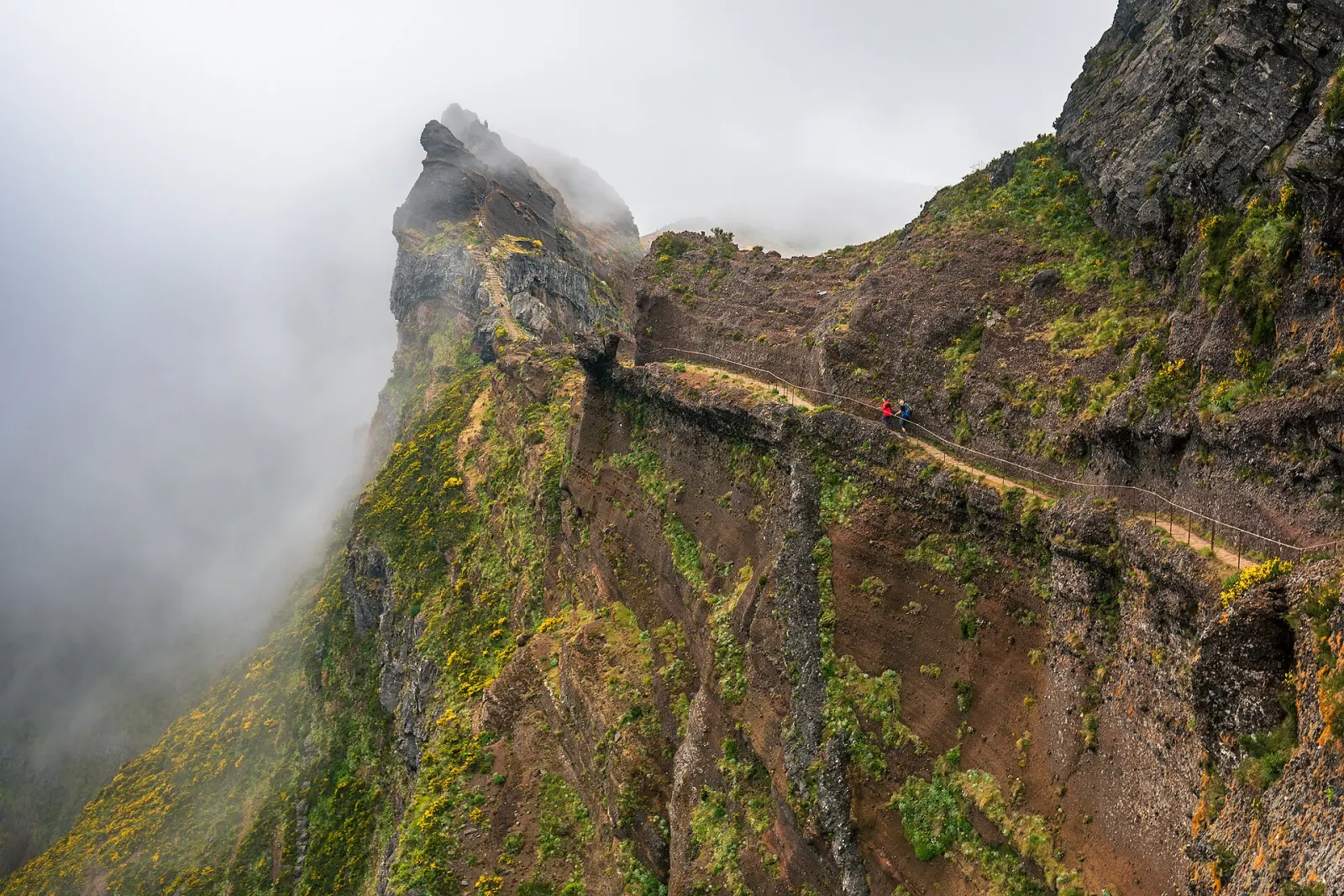
- Drops hidden by vegetation. The official panels warn that the routes are not dangerous in themselves but can hide fatal drops, often covered by plants. Do not step off the path for a photo.
- Wet, slippery and uneven ground, especially on levada walls and in the laurel forest.
- Rockfall and landslides. IFCN describes the routes as subject to strong climatic pressure and natural erosion. If a landslide, fallen tree or heavy rain blocks the way, the panels' instruction is to turn back the way you came.
- Wind on exposed ridges. On the high ridges between the peaks there is little shelter. Strong wind is one of the conditions in which IFCN says not to walk.
- Vertigo. The PR 9 panel warns of the risk of vertigo on exposed sections.
- Narrow paths with two-way traffic. Let others pass where it is safe, on the side away from the drop.
What happens if something goes wrong?
Call 112 and describe where you are: the route code (for example "PR 1") and the last landmark you passed. The trail panels also give the Regional Civil Protection number, +351 291 700 112, and recommend the Prociv Madeira app, which shows official warnings.
Rescue is always provided. Since January 2025, however, Portaria n.º 72/2025 allows the Regional Civil Protection Service to charge non-residents for helicopter rescues on unclassified routes and on closed trails: a daily helicopter rate of €753.25, €105 per rescuer activation (€210 when two rescuers are needed) and €7.50 per minute of flight.
Entering a closed trail is also an offence in its own right. Article 13 of Decreto Legislativo Regional n.º 24/2022/M sets fines of €250 to €2,500 for individuals.
What do walkers most often misjudge?
- "Signposted means safe." IFCN states that an approved, waymarked route is not a guarantee that it is safe to walk at every time of year.
- "A booking means the trail is open." Statuses can change after you book. Check again on the morning.
- "A phone light will do." In wet tunnels with uneven floors you want a proper torch and both hands free.
- Starting late. Long levadas take longer than their distance suggests; plan with the panel's official time.
- Following app tracks. Routes shared on apps often use unclassified or closed paths, where both rescue charges and fines apply.
For the bigger picture of when to go, see the best time to visit Madeira, or browse all hikes.
Sources and fact-checking
Facts checked against the sources below on 28 October 2026. How we work
- IFCN — Percursos Pedestres Classificados (official list and status, updated 2 Oct 2026)
- IFCN — Percursos pedestres: avisos (trail notices, updated 14 Sep 2026)
- IFCN — FAQ: fees and booking for classified walking routes (2026)
- IFCN — Precauções e conselhos aos pedestrianistas / Dicas para o pedestrianista
- JORAM — Decreto Legislativo Regional n.º 24/2022/M (walking-route regime, Art. 13 fines)
- Visit Madeira — Mountain rescue costs (Portaria n.º 72/2025)
Photos: Ximonic (Simo Räsänen) (CC BY-SA 4.0)