Madeira Embroidery and Crafts: How to Recognise Authentic Bordado Madeira
Madeira embroidery is hand-stitched, regulated by law and certified piece by piece with an IVBAM guarantee seal. Its history, how a piece is made, how to spot the real thing, Camacha wicker and other crafts.
28 October 2026 · 5 min read
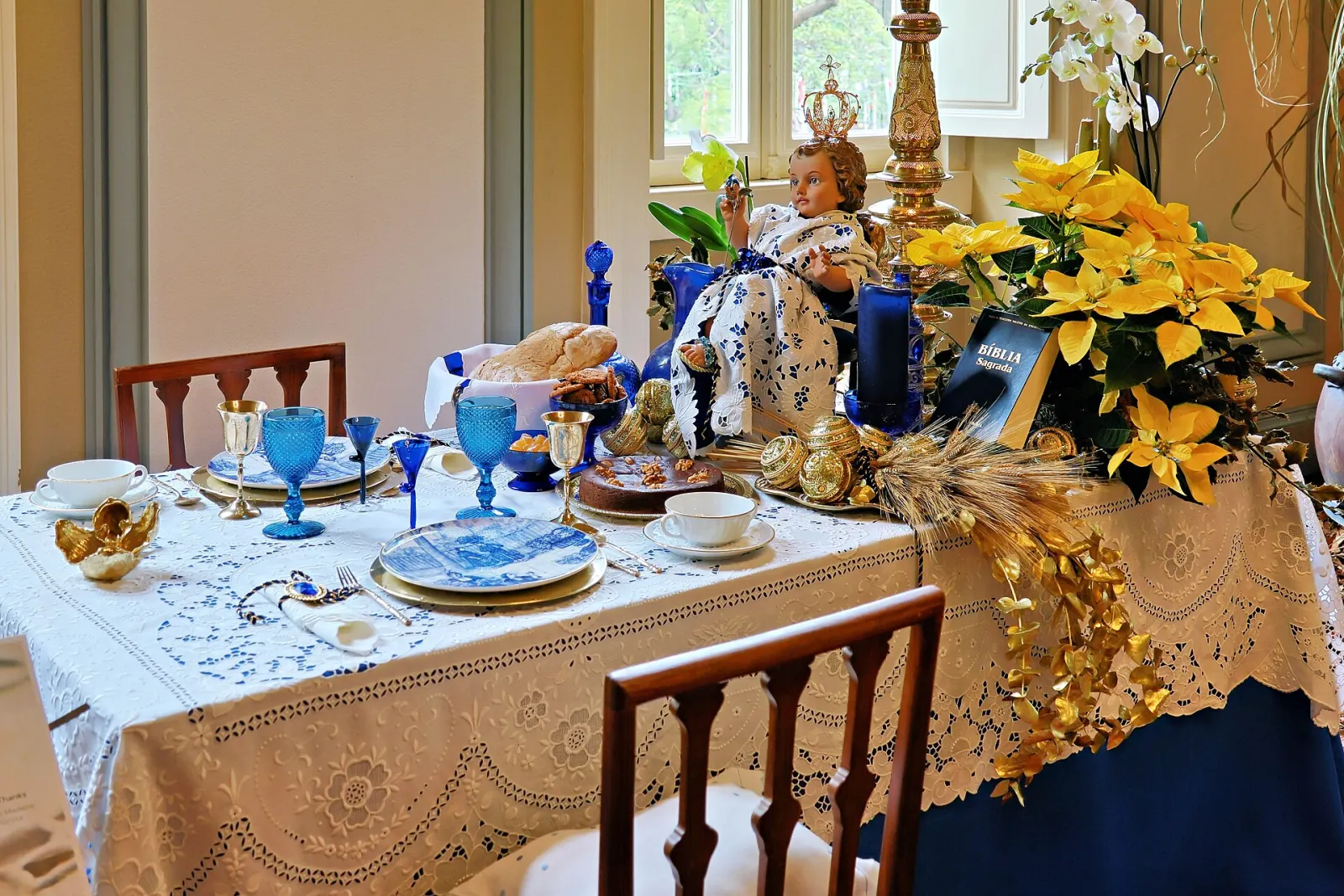
Bordado Madeira (Madeira embroidery) is hand embroidery made on the island under rules set in regional law, and every authentic piece is inspected and sealed by the Madeira Wine, Embroidery and Handicrafts Institute (IVBAM) before it can be sold. It grew from a domestic craft into an export industry after 1850, and today it sits alongside Camacha wicker and other traditional crafts as Madeira's best-known handmade products. If you plan to buy a piece, the guarantee seal is the single most important thing to look for.
Key facts
- Certifying body: IVBAM, IP-RAM (Instituto do Vinho, do Bordado e do Artesanato da Madeira), which checks each piece and applies a guarantee seal.
- Legal basis: the permitted fabrics, threads and stitches are defined in Regional Legislative Decree no. 7/91/M of 15 March.
- Turning point: an exhibition of Madeiran industries at the Palácio de São Lourenço in 1850, followed by the Great Exhibition in London in 1851.
- The seal: since October 2000 a holographic seal has replaced the lead seal used previously (Klut, 2003).
- Size of the sector: about a dozen companies and around 1,000 embroiderers, according to Visit Madeira.
- Camacha wicker: the wicker industry in Camacha began in 1850.
What is Bordado Madeira?
It is a regulated, hand-worked embroidery, usually with naturalistic motifs inspired by Madeira's flora combined with geometric forms. IVBAM's official embroidery site lists the materials allowed by law: natural silk, terylene, linen and organdie for all articles, linen-cotton blends with at least 50% linen, and specific cottons and wools for particular items. Only silk embroidery thread and cotton floss of at least no. 16 thickness are permitted.
The permitted stitches fall into three groups: openwork (arrendados, such as ponto Ana, crivo and escada), stitches worked over padding (lançados sobre urdidura, including bastido, caseado, ilhó, cordão and Richelieu) and others (such as pesponto, francês, sombra, corda, granito and matiz). Visit Madeira notes that, depending on the size of the design, a single piece can take several months to embroider.
How did it become an export industry?
Embroidery probably arrived with the first settlers in the 15th century and was long practised by women of wealthy families and in convents for clothing and trousseaux. According to IVBAM, the shift to a commercial activity came with an exhibition of Madeiran industries at the Palácio de São Lourenço in 1850. Its success led to an invitation to the Great Exhibition in London in 1851, where the pieces were praised for their "purity" and "artistic perfection".
Exports went first to the United Kingdom and, by the end of the 19th century, to Germany; in the 20th century they reached Italy, the United States, South America and Australia. IVBAM lists the United States, Italy and England as today's main markets. The Englishwoman Elizabeth Phelps (1820–1893) is traditionally credited with boosting the craft by teaching embroidery from her home in the 1850s — Largo Phelps in central Funchal carries her family's name.
How is a piece made?
IVBAM describes a production chain that still involves several specialists:
- Design — a designer draws the motif on tracing paper.
- Perforation (picotagem) — the outline is pricked with a needle machine; a curvímetro then counts the number of stitches, which sets the embroiderer's pay.
- Stamping — the perforated design is laid on the fabric and a washable blue ink transfers it.
- Embroidery — the fabric goes to embroiderers, who work at home.
- Finishing — back at the company, pieces are checked, cut, washed and ironed.
- Certification — IVBAM inspects the finished work and applies the guarantee seal.
The faint blue lines you may see on an unfinished piece are the stamping ink, which washes out.
How do you recognise authentic Madeira embroidery?
- Look for the IVBAM guarantee seal. IVBAM states that it checks every piece of Bordado Madeira and affixes a guarantee seal certifying its quality and authenticity. Since October 2000 that seal has been holographic; before that, pieces carried a small lead seal attached with threads in three colours — purple, yellow and red — which you may still find on older or second-hand items.
- Expect natural fibres and a high price. Linen, silk, organdie and fine cotton are the norm, and a large tablecloth represents months of work.
- Buy from a known outlet. Visit Madeira lists the IVBAM handicraft shop (Rua dos Ferreiros 152 and Rua 5 de Outubro 78, Funchal) and Bordal (Rua Dr. Fernão de Ornelas 77, Funchal) as places to buy. Many embroidery companies also have showrooms in central Funchal.
- If in doubt, ask IVBAM. The institute can be contacted at ivbam@madeira.gov.pt or +351 291 145 630.
Can you visit the embroidery museum?
The IVBAM Museological Nucleus (Museu do Bordado) at Rua Visconde de Anadia 44, Funchal, holds Madeira embroidery from the 1860s to the 1930s, displayed in rooms recreating 18th- and 19th-century interiors, including clothing, bed linen and items used in production. As of October 2026, IVBAM's own site lists it as temporarily closed. When open, it has operated Monday to Friday, 09:00–12:30 and 14:00–17:30 (closed weekends and holidays), with a €2 ticket. Check before going.
IVBAM also runs public events, such as an annual Madeira Embroidery Week around World Embroidery Day (30 July) and demonstrations during the Flower Festival.
What is Camacha wicker?
Wickerwork comes from Camacha, a parish in the municipality of Santa Cruz in eastern Madeira, where altitude and water favoured willow growth. Visit Madeira dates the industry to 1850. The canes are cut, peeled and dried, then boiled — which makes them flexible and gives them their brown colour instead of the original white. They are used for baskets, bags, furniture, the grape-harvest baskets and the basket sledges of the Monte toboggan. Most production has always been exported, mainly to the United States and central Europe. Visit Madeira notes that the large workshops have closed and few artisans still work wicker, often to order from their homes.
What other traditional crafts should you know?
- Botas de vilão — tall handmade leather boots once worn across the island. Women's versions had a thin red leather strip; the rubber-soled "country boot" is still used by the Monte sledge drivers as a brake.
- Barrete de orelhas — a wool cap with ear flaps, historically worn by shepherds in the mountains.
- Musical instruments — handmade instruments used in traditional Madeiran music.
- Other crafts listed by Visit Madeira include sugarcane and wood items, ceramics, dolls in regional costume, and miniature basket sledges and Santana houses.
What do visitors commonly get wrong?
- Assuming "Madeira-style" means Madeira-made. Without the IVBAM seal, a piece is not certified Bordado Madeira.
- Comparing prices with machine-made linen. The cost reflects the stitch count that sets the embroiderer's pay.
- Planning a museum visit without checking. The embroidery museum is temporarily closed as of October 2026.
Sources and fact-checking
Facts checked against the sources below on 28 October 2026. How we work
- IVBAM — Bordado Madeira: história, pontos e matérias-primas, processo produtivo, selo de certificação
- IVBAM — Museu do Bordado: horário e condições de visita (temporarily closed)
- Visit Madeira — Madeira Embroidery
- Visit Madeira — Madeira Crafts and Madeira Wicker
- Klut, A. T. (2003) — Economuseu Casa de Bordados, MA dissertation, ULHT (holographic seal since Oct 2000)
- Wikipedia (pt) — Bordado da Madeira
Photos: Dr. Thomas Liptak (CC BY-SA 4.0)