Funchal Old Town (Zona Velha): a walking guide
Rua de Santa Maria and its painted doors, the Capela do Corpo Santo, the Fortaleza de São Tiago and the cable car base — what each is and how to link them on foot.
28 October 2026 · 6 min read
Funchal's Zona Velha (Old Town) is the compact quarter on the east side of the city centre where, according to the municipality, the city's first settlement was established. Its spine is Rua de Santa Maria, a 600 m cobbled street known for the "artE de portas abErtas" painted-doors project, with a 15th-century fishermen's chapel at one end of the quarter and a 17th-century fortress at the other. Everything in this guide can be walked in a morning or late afternoon, and it starts or ends conveniently at the Mercado dos Lavradores or the cable car to Monte.
Key facts
- Where: parish of Santa Maria Maior, east of Funchal's centre — the first parish created on the island.
- Rua de Santa Maria: about 600 m, from the João Gomes stream at Rua Brigadeiro Oudinot to the Largo and Church of Socorro.
- Painted doors: project "artE de portas abErtas" (Projeto Arte Portas Abertas), running since 2011, with about 200 painted doors.
- Capela do Corpo Santo: built by Funchal's fishermen in the late 15th century.
- Fortaleza de São Tiago: begun around 1614 to defend the city from pirates.
- Evening: restaurants, terraces, poncha bars and fado houses along Rua de Santa Maria.
What is the Zona Velha?
The Funchal municipality describes the Old Town as the place where, as the story goes, the city's first settlement was established. It is characterised by narrow cobbled streets and the façades of old houses, and is considered a historic area of high architectural and heritage value. It lies in the parish of Santa Maria Maior, which was the first parish created on the island.
Today the quarter is a mix of long-standing residents and businesses. The municipality notes that families have lived on Rua de Santa Maria for generations, while almost its entire length also has restaurants and terraces. The Old Town takes on a different life at night, when it becomes one of Funchal's main areas for eating out and entertainment.
What is special about Rua de Santa Maria?
Rua de Santa Maria is one of Funchal's original streets. According to the municipality, it runs for about 600 metres of cobbles from the João Gomes stream, at Rua Brigadeiro Oudinot, to the Largo and Church of Socorro, and takes only a few minutes to walk end to end — though most visitors take much longer because of the doors.
Soon after settlement began, a small church called Santa Maria do Calhau was built here and became a meeting point; the street ran parallel to the beach, on flat ground that made it easy to open. Some details reward a slower walk:
- the building of the former boys' and girls' primary schools, which kept the sexes apart even in the playgrounds, now used by a hostel and a restaurant terrace;
- one of the stations of the Via Sacra along the street;
- the narrow alleys crossing it, which cars can still use — watch for traffic;
- on 1 May, the feast of São Tiago Menor, patron saint of Funchal, a procession passes along the street.
At the eastern end, the street reaches the Church of Socorro, and the municipality notes a small viewpoint at the top with a panoramic view over the city.
What is the painted-doors project?
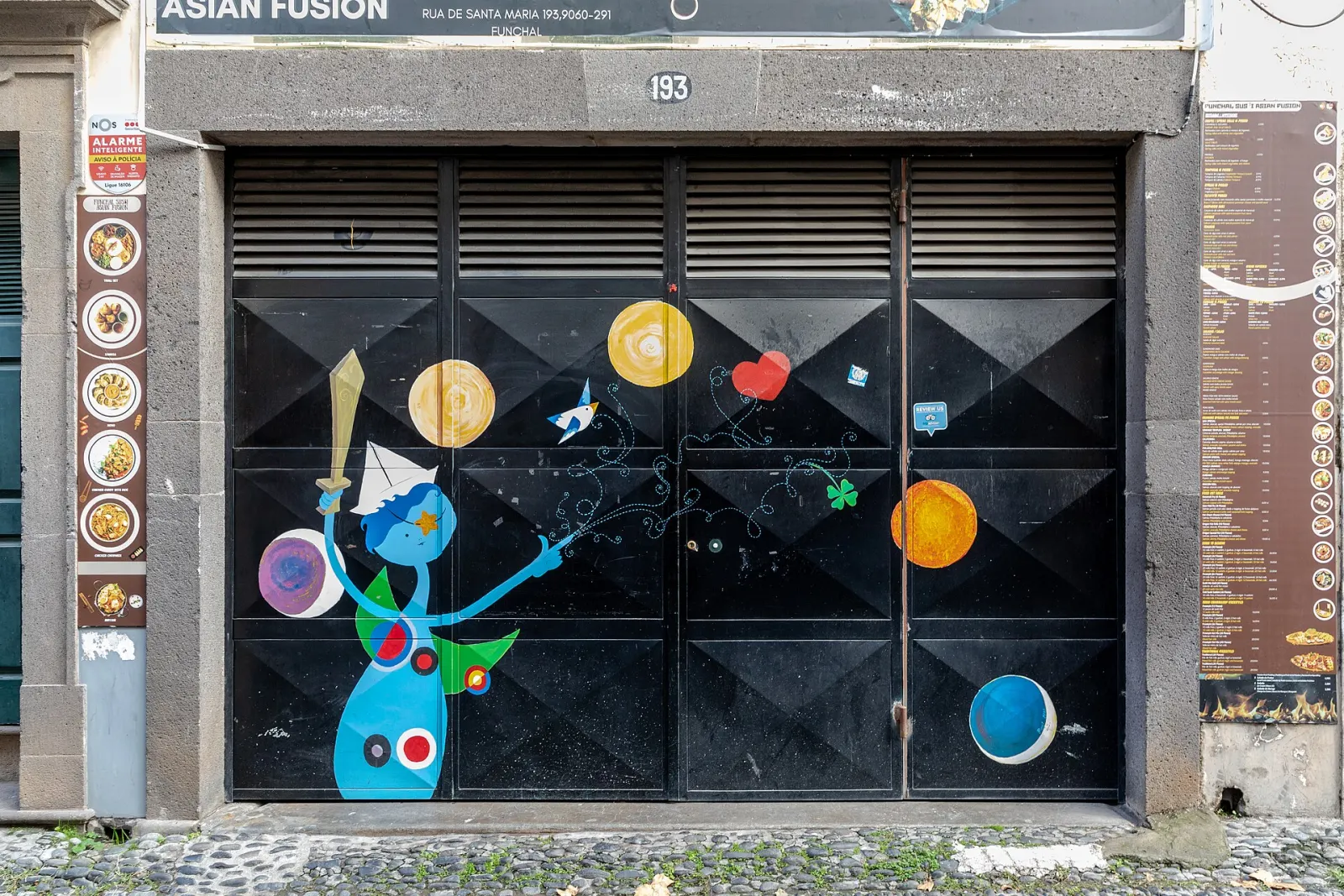
The project is called "artE de portas abErtas" (the art of open doors; the municipality lists it as Projeto Arte Portas Abertas). Since 2011 artists, coordinating with the city council, have painted the doors of houses, abandoned shops and run-down buildings in the Old Town, especially on Rua de Santa Maria. The aim, in the municipality's words, is to open the city to artistic and cultural events and to turn the oldest part of the city into a permanent gallery.
The municipality counts about 200 painted doors on Rua de Santa Maria, with contributions from well-known names in Madeiran art and design, including the architect Paulo David and the designer Nini Andrade Silva. Works range from flat paintings to three-dimensional pieces.
Many doors belong to restaurants and bars, so they are often hidden by open shutters or terrace furniture in the evening. For photographs of the doors themselves, a morning walk, before businesses open, usually works better.
What is the Capela do Corpo Santo?
The Capela do Corpo Santo is one of the few 15th-century buildings in Funchal that survive, according to the municipality. Visit Madeira describes it as one of the oldest churches on the island, built by Funchal's fishermen at the end of the 15th century and dedicated to São Pedro Gonçalves Telmo, patron saint of fishermen and sailors. For many years it also served as a mutual-aid association, supporting fishermen and their families after accidents at sea or illness.
Several restorations have shaped the building. Its simple pointed-arch portal dates from the 15th century, while the interior reflects alterations of the 16th and 17th centuries. The highlight is a painted panel showing São Pedro Gonçalves Telmo blessing a Manueline caravel, which Visit Madeira suggests is one of the oldest depictions of a ship in Madeira.
What is the Fortaleza de São Tiago?
The Fortaleza de São Tiago stands on the shore at the eastern edge of the Old Town. According to the municipality, work began around 1614 to protect Funchal from pirate attacks. It was started by the royal master builder Jerónimo Jorge and completed by his son Bartolomeu João, with the engineer Tossi Colombina — author of the project for Funchal's port — involved in the works. The first phase finished in the 17th century and a second phase followed around the 18th century.
Over the centuries the fortress has housed British troops, the Army Police and the Funchal Lancers Squadron, and it sheltered victims of the 1803 flood. The address is Rua do Portão de São Tiago, and the municipality lists the regional culture department as its contact (telephone 291 213 340), so check opening times there before planning a visit inside.
How do you walk the Old Town?
A logical one-way route, starting from the market and ending at the cable car:
- Mercado dos Lavradores, on Rua Brigadeiro Oudinot. Official hours are Monday to Friday 07:00–19:00 and Saturday 07:00–14:00; it is closed on Sundays and public holidays.
- Cross the João Gomes stream and enter Rua de Santa Maria at its western end.
- Walk Rua de Santa Maria (about 600 m) looking at the doors, to the Largo and Church of Socorro.
- Fortaleza de São Tiago, on the shore, a short walk east of the church.
- Return west along the seafront side of the Old Town to the Capela do Corpo Santo.
- Funchal cable car lower station, on Rua Dom Carlos I at the edge of the Old Town, for the ride up to Monte.
If you plan to ride the cable car, do the walk in the morning: it runs from 08:45 to 17:45. If you mainly want the Old Town atmosphere and its restaurants, reverse the order and walk in the late afternoon, ending on Rua de Santa Maria as it fills up.
Where do people eat in the Old Town in the evening?
Rua de Santa Maria and the surrounding alleys are the Old Town's dining area. The municipality describes the street as having restaurants and terraces along almost its whole length, with menus ranging from traditional to international cuisine, numerous bars serving poncha and local fruit drinks that stay open late, and some fado houses. This guide does not recommend individual restaurants. For the dishes and drinks to look for, see what to eat in Madeira, and for the rest of the city, the Funchal region guide.
Sources and fact-checking
Facts checked against the sources below on 28 October 2026. How we work
- Visit Funchal (Câmara Municipal do Funchal) — Zona Velha da Cidade (Old Town)
- Visit Funchal — Rua de Santa Maria (streets with history)
- Visit Funchal — Projeto Arte Portas Abertas
- Visit Funchal — São Tiago Fortress
- Visit Madeira — Capela do Corpo Santo
- Wikipedia — Funchal (street art: ArT of opEN doors project, since 2011)
Photos: Dietmar Rabich (CC BY-SA 4.0)