Whale and dolphin watching in Madeira: species, seasons and the rules
28 cetacean species confirmed around Madeira, what research says about each season, the legal approach rules for boats and how to check an operator is authorised.
28 October 2026 · 6 min read
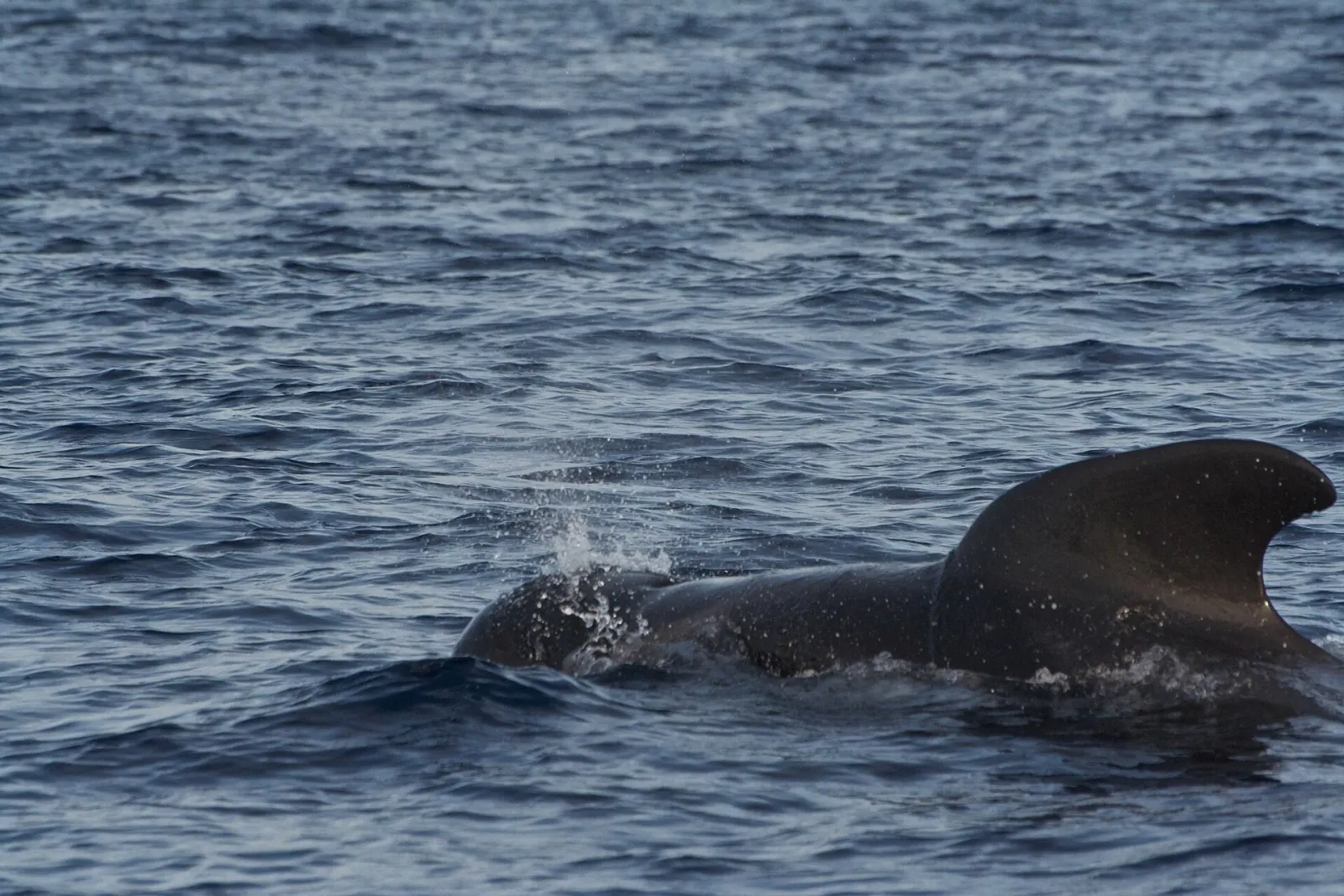
Madeira is one of the few places in Europe where whales and dolphins can be seen all year from a short boat trip. The Museu da Baleia da Madeira counts 28 cetacean species confirmed in the archipelago, and the activity is governed by a specific regional law, Decreto Legislativo Regional n.º 15/2013/M, which sets distances, speeds and time limits for every boat. Below: species by season, the legal rules and how to check an operator.
Key facts
- Species confirmed: 28 in the Madeira archipelago — 7 baleen whales and 21 toothed whales and dolphins (Museu da Baleia da Madeira, 2025).
- Law: Decreto Legislativo Regional n.º 15/2013/M, of 14 May 2013 — the regulation on observing marine vertebrates in the Autonomous Region of Madeira.
- Closest a boat may actively approach: 50 m for any marine mammal; 25 m for sea turtles.
- Time with the animals: up to 10 minutes per boat, and 40 minutes in total for all boats with the same group.
- Night watching: prohibited, except for seabirds and authorised scientific or filming work.
- Whale museum: Museu da Baleia da Madeira, Caniçal — open Tuesday to Sunday, 10:00–18:00.
Which whales and dolphins can you see around Madeira?
Of roughly 78 cetacean species known worldwide, 28 have been confirmed in Madeiran waters, either regularly or occasionally, according to the Museu da Baleia da Madeira. Seven belong to the baleen whales (Mysticeti) and 21 to the toothed whales (Odontoceti), which include the dolphins, pilot whales and the sperm whale.
The museum notes that the large baleen whales use these waters in passing or seasonally, with some individuals staying for several months. Fin whales, Bryde's whales and sei whales have been seen feeding, and calves have been confirmed for fin and Bryde's whales. Among the toothed species, some are present seasonally — the museum gives the common dolphin as an example — while others, such as the bottlenose dolphin, are present all year.
When is the best season for each species?
There is no single best month, because different species peak at different times. The most detailed public evidence is a 2021 study in Frontiers in Marine Science (Fernandez, Alves and colleagues), which modelled 8,607 sightings of 23 species recorded from whale-watching boats on 3,138 days between January 2003 and December 2018. It models habitat suitability, not guaranteed sightings, but the seasonal patterns are clear:
| Species | Higher suitability (2003–2018 model) |
|---|---|
| Bottlenose dolphin | All year, almost no seasonal variation |
| Short-beaked common dolphin | December to June (winter and spring) |
| Atlantic spotted dolphin | June to October |
| Short-finned pilot whale | Late summer, autumn and winter; lower from March to July |
| Bryde's whale | Slight increase from June to January |
| Sperm whale | June to November |
| Fin whale | February to May |
| Striped dolphin | Spring to early summer |
| Rough-toothed dolphin | July to October |
| Blainville's beaked whale | Summer and early autumn |
The mix changes through the year: March favours common dolphins and fin whales, August spotted dolphins, Bryde's whales and sperm whales. Sea state matters as much as the calendar: animals are much easier to spot on a calm day, and the north coast is usually rougher than the south.
What does the law say about approaching whales and dolphins?
Decreto Legislativo Regional n.º 15/2013/M applies to commercial trips, scientific work and private recreational boats alike. The main rules for cetaceans are in articles 6 to 9 of the regulation:
- Approach zone (300 m): a boat is "approaching" once it is within 300 m of the nearest animal or group. Between 300 m and 100 m it must never exceed 12 knots; between 100 m and 50 m, never more than 8 knots.
- Minimum distance: active approach closer than 50 m to any marine mammal is prohibited. If the animals come to the boat themselves, it must keep its initial course and speed.
- Angle of approach: boats move parallel to and slightly behind the animals, at roughly 30° to their direction of travel, leaving them a free 180° field ahead — never head-on, directly behind or across their path.
- Time limits: each boat may stay in the observation area for up to 10 minutes, and all boats together for a maximum of 40 minutes, counted from the arrival of the first.
- Number of boats: on the south coast between the eastern limits of the Santa Cruz and Calheta municipalities (Area I), up to two boats may be between 50 and 100 m, two between 100 and 300 m and four between 300 and 500 m. Elsewhere (Area II) the limits are one, one and two.
- Waiting time: boats queuing outside the approach area must wait at least 120 minutes after the last boat has left before entering it.
The regulation also lists prohibitions that matter to passengers: chasing animals, separating a group or isolating calves, touching them, throwing anything at them, using sonar, reversing except in emergencies, and flying over marine mammals below 300 m altitude or within 150 m. Aircraft and jet-skis may not be used as observation platforms, except for science or authorised filming. Swimming with marine mammals is prohibited; the only exception the law allows is underwater observation of two dolphin species — the common dolphin and the Atlantic spotted dolphin — with at most four people holding on to a line attached to the boat.
How many whale-watching boats are allowed?
The law caps the activity. Portaria n.º 46/2014, of 22 April, set a maximum of 21 platforms based in the harbours and marinas of Machico, Santa Cruz, Funchal and Câmara de Lobos; 6 in Ribeira Brava, Ponta do Sol and Calheta; 6 in Porto Moniz and São Vicente; and 4 in Porto Santo. Each platform may make at most three trips a day. The same Portaria defined an area of 1,021 km² where cetacean watching is excluded.
How do you choose a responsibly authorised operator?
This guide does not recommend operators. Instead, the regulation gives you concrete things to check:
- Authorisation. Commercial trips need an authorisation from the regional nature conservation service, and only licensed tourist-entertainment companies or maritime-tourism operators registered with the maritime authority can obtain one. Operating without it is classed as a very serious offence, with fines of €15,000 to €40,000 for companies.
- Licence on display. Operators must display their licence in a clearly visible place at the reception point, on the boat and in any vehicles used to take clients to the boat.
- Flag and radio. Authorised boats must fly an identification flag for the activity and carry a working VHF radio, which is how skippers coordinate turns around a group.
- Briefing. Operators must tell passengers about the species and their ecosystem and summarise the code of conduct, and keep a copy of the regulation on board.
- No swim-with promises. An offer to swim with whales or with any species other than the two dolphins named above, or a promise of very close encounters, contradicts the law.
On board, the official signs of disturbance are worth knowing: a marked change of direction or speed, evasive swimming, longer dives and shorter time at the surface, repeated tail slaps, and adults placing themselves between calves and the boat. When animals show these signs, the boat must withdraw behind them.
What can you see at the Museu da Baleia in Caniçal?
The whale museum tells the other side of the story. Its creation was proposed to the Machico municipality in 1989 by Eleutério Reis, the last manager of the Empresa Baleeira da Madeira, who became its first director. It was formally created on 26 February 1990 and opened on 28 May 1990 in Caniçal's old fish market, to preserve the memory of the whaling carried out in the archipelago for 40 years, from 1941 to 1981, with Caniçal at its centre. In 1996 it set up the region's cetacean stranding network, and on 2 September 2011 it opened its current building.
The two permanent exhibitions cover the history of whaling and cetaceans and the marine environment. Practical details from the museum's site:
- Address: Rua Garcia Moniz 1, 9200-031 Caniçal (GPS 32.735911, -16.740579).
- Opening hours: Tuesday to Sunday, 10:00–18:00.
- Tickets (price list of July 2026): adult €15; child 6–11 €7.50; 12–17 and students €10; over 65 €10. Entry is free on 18 May and 27 September.
- Getting there: SIGA bus line 113, or by car on the Funchal–Caniçal expressway, exit "Caniçal Oeste", then follow signs to the museum.
Caniçal is also the gateway to the Ponta de São Lourenço trail and the small Prainha do Caniçal, so the museum fits easily into a day in the east of Madeira. For marine life you can see from the shore or underwater, see the Garajau marine reserve.
Sources and fact-checking
Facts checked against the sources below on 28 October 2026. How we work
- Decreto Legislativo Regional n.º 15/2013/M — Regulamento da Atividade de Observação de Vertebrados Marinhos (Diário da República, 14 May 2013, via IFCN)
- Portaria n.º 46/2014 — carrying capacity for cetacean watching (JORAM I série n.º 58, 22 April 2014)
- Museu da Baleia da Madeira — Baleias e Golfinhos na Madeira (species confirmed)
- Museu da Baleia da Madeira — História do Museu
- Museu da Baleia da Madeira — Tarifário (2026) and Como chegar
- Fernandez et al. (2021), Modeling Fine-Scale Cetaceans' Distributions in Oceanic Islands: Madeira Archipelago as a Case Study, Frontiers in Marine Science 8
Photos: Alexander Baxevanis (CC BY 2.0)